i'm still thinking about "Halo: Reach"
- Raegan Blair
- Nov 14, 2025
- 3 min read

In terms of post-colonialism, I mean. I got to talking with one of my friends, who happens to be like, a Halo lore expert, about my last post. He started talking to me about the Halo books, which I haven't read (I promise I'm not a fake fan though), but conveniently explain a lot of the things I was questioning in my larger Halo post. I'm still attached to this post-colonialist read of things, specifically as I thought more and more about Halo: Reach. Even more specifically, I was thinking of the infamous ending--spoilers ahead for that.
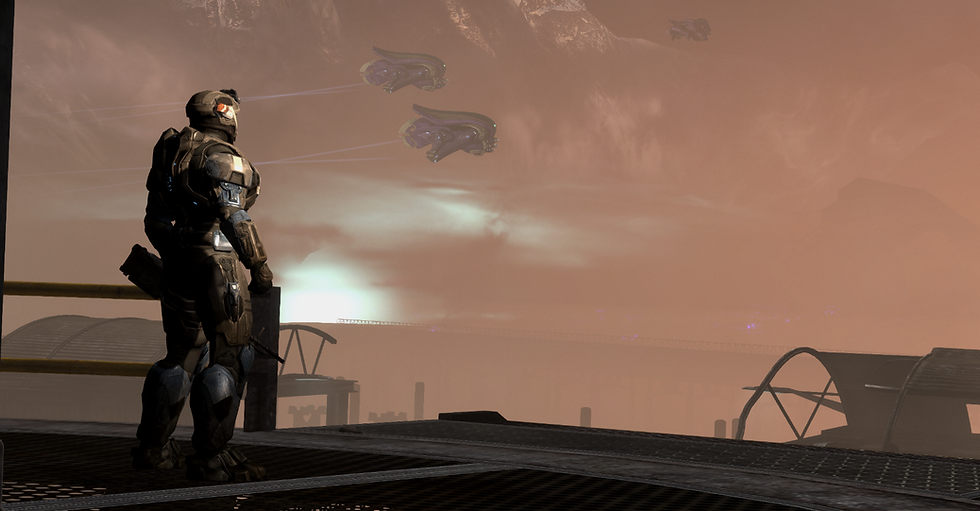
https://wall.alphacoders.com/big.php?i=1219707, Noble 6 watches as he's abandoned on Planet Reach.
There's one, notorious objective whenever you reach the final mission in Halo: Reach. Survive. There are no checkpoints, no map markers, nothing. And you can't survive, really. Planet Reach is destined to fall, Noble 6 is destined to die (with some of the most gut-wrenching soundtrack, might I add). The covenant wipes out all of Reach, decimating what is effectively the largest, most important colony established by the human race--under the direction of the UNSC--on a different planet.
Even though Halo: Reach doesn't directly address the colonization of these planets as a central theme, they are established--for better or for worse. Reach basically becomes a second Earth, and a hub for military and scientific activity. It makes perfect strategic sense as to why the Covenant would want to target something like that. But outside of the story of the game, I'm still wondering why UNSC didn't retreat as soon as the realized they were severely out-matched. What's the motive behind risking the lives of hundreds of thousands of people, just to preserve a place of military and scientific command? It's clear us humans were way out of our depth in the first place, so why not just cut our losses?
Well, my greed guess wasn't too far off. It was also control--apparently there were tons of insurrectionists scattered across these colonies that were trying to resist UNSC command. This insurrection is what caused the creation of the super-human Spartans; ironically, they were trying to control other humans, not any alien life form. It was out of convenience that the UNSC had the Spartans ready to go whenever the Covenant did attack, but not before humanity brought there own fights into space. And I'm sure you can guess how well that went. It wasn't until after Reach fell that the UNSC decided to retreat to the Sol system--where Earth is.
So what does this have to do with the ending of Halo: Reach? And what does it have to do with this post-colonialist theory? Well, prior to framing the game in this view, I always thought of the ending of Halo: Reach as something heroic, selfless--Noble 6 became a martyr for humanity's resilience in the face of alien threats. But it's this human need for control that pushed people, and the UNSC, so deep into space in the first place. We took our conflicts somewhere they didn't belong, and eventually, we paid the price for it. Keeping in mind that colonist narrators are always unreliable under post-colonialist theory, the ending of Halo: Reach becomes a lot more tense, a lot more sour. Noble 6 is just a cog in a larger, human-driven conflict. He died doing what he believed was right, because that's what he was told. And partly, he did do the right thing, as much as he could. Really, it was mostly damage control--things would somehow be way worse if he didn't succeed on his mission. And that's saying something.
What did Noble 6 die for? When the game tells you to survive, what is it that you're fighting for, really? To lead Cortana, and then the UNSC to a Halo ring? Or is it a consequence of a prolonged human conflict brought into space, that's quickly spiraling out of our control? This view of the ending of Halo: Reach as an entire new level of nuance to an already fantastic game and story. But either way, I still can't help but feel bad for Noble 6. He was a hero in a conflict that didn't care about him.


Comments